
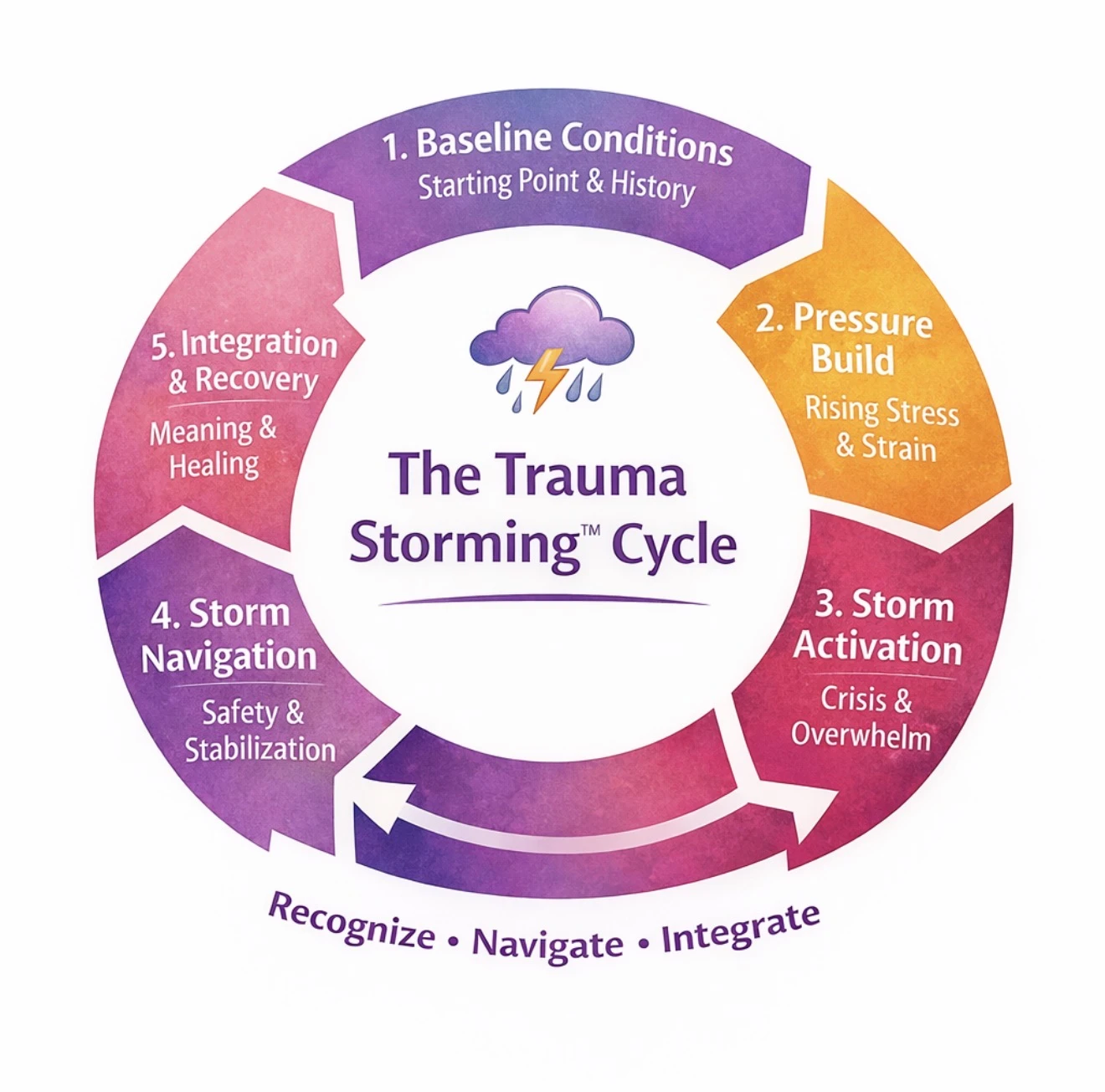
Trauma Storming™
A Trauma-Informed Clinical Framework for Navigating Trauma as a Dynamic System
Trauma Is Not a Personal Failure
Trauma does not mean something is wrong with you.
It means your nervous system adapted to survive conditions that exceeded what one person should have had to carry alone.
At Heart Mind Body, we understand trauma not as a single event or diagnosis, but as a living process—one that moves through the body, mind, emotions, and relationships across time.
Trauma Storming™ is the clinical framework we use to understand and work with that process.
What Is Trauma Storming™?
Trauma Storming™ is a trauma-informed clinical framework that views trauma responses as dynamic, cyclical, and adaptive, rather than disordered or broken.
We use the metaphor of a storm because trauma often behaves like one:
pressure builds beneath the surface
internal systems become overwhelmed
reactions can feel sudden or out of control
calm may return, but the impact remains
Rather than trying to eliminate the storm, Trauma Storming™ helps individuals recognize, prepare for, and safely navigate these internal experiences—with structure, support, and compassion.
Why a Systems-Based Trauma Framework Was Needed
Many clients seek care after being told:
“You should be over this by now.”
“Your symptoms don’t fit neatly into a diagnosis.”
“You’ve tried everything—nothing works.”
Traditional models often focus on isolated symptoms, without fully accounting for:
nervous system dysregulation
attachment history
cumulative or developmental trauma
chronic stress and burnout
mind-body interactions
Trauma Storming™ was developed to address trauma as a whole-system experience, integrating neuroscience, psychophysiology, psychiatric care, and relational safety into a single, coherent clinical lens.
The Trauma Storming™ Cycle
While every individual’s experience is unique, trauma often follows a recognizable pattern. Trauma Storming™ describes this pattern as a cycle, not a linear path.
1. Baseline Conditions
This reflects the state of the nervous system before stress escalates.
It includes:
long-standing stress or burnout
early life and relational experiences
medical and mental health history
current life demands and supports
Understanding baseline conditions helps identify vulnerability before crisis occurs.
2. Pressure Build
Stress accumulates when demands exceed regulatory capacity.
Clients may notice:
increasing anxiety or irritability
physical or somatic symptoms
sleep disruption
emotional numbing
intensified coping behaviors
In Trauma Storming™, this phase is clinically meaningful, not something to ignore or push through.
3. Storm Activation
This is when the trauma system fully activates.
Experiences may include:
panic, shutdown, or dissociation
emotional flooding
impulsive or reactive behavior
feeling suddenly “out of control”
During this phase, Trauma Storming™ prioritizes safety, grounding, and nervous system stabilization, rather than forced insight or cognitive processing.
4. Storm Navigation
This is where guided clinical support matters most.
With trained clinicians, clients learn to:
stabilize physiological responses
track internal experience without judgment
restore a sense of agency and choice
reduce harm during activation
Navigation may include therapy, medication management, somatic strategies, relational repair, and integrative mind-body approaches—always tailored to the individual.
5. Integration & Recovery
After the storm passes, Trauma Storming™ emphasizes integration, not simply “returning to normal.”
This phase may include:
meaning-making without retraumatization
identity repair and boundary strengthening
skill consolidation
increased resilience for future stress
Over time, individuals develop storm literacy—the ability to recognize early signals, intervene sooner, and recover more efficiently.
How Trauma Storming™ Is Integrated Into Care at Heart Mind Body
At Heart Mind Body, Trauma Storming™ is not a standalone technique or marketing concept. It is a clinical lens that informs how care is delivered across disciplines—from the first point of contact through long-term treatment planning.
This framework guides assessment, pacing, intervention selection, and clinical decision-making, ensuring care is trauma-informed, nervous-system respectful, and individualized.
Trauma-Informed Assessment From the Start
From intake forward, clinicians assess:
nervous system patterns and stress tolerance
trauma history across developmental, relational, and medical domains
baseline conditions and resilience factors
prior treatment experiences and retraumatization risks
Care begins by asking:
Where is pressure already building in this system—and what support is needed first?
Individualized Care Planning
Treatment plans are developed to match:
the client’s current storm phase
their regulation capacity
life context and support systems
Care may include psychiatric medication management, trauma-informed psychotherapy, somatic strategies, attachment-focused work, and integrative approaches aligned with client values. Interventions are sequenced intentionally, not layered all at once.
Storm-Sensitive Timing
A core principle of Trauma Storming™ is that timing matters.
At Heart Mind Body:
stabilization precedes deep trauma processing
insight is never forced during acute activation
exposure-based approaches are used cautiously and ethically
pacing is adjusted based on real-time nervous system cues
This reduces symptom escalation, treatment dropout, and retraumatization.
Ongoing Navigation & Support
Clients are supported in:
recognizing early warning signs
developing personalized grounding strategies
strengthening boundaries and relational safety
normalizing setbacks without shame
Over time, this builds confidence and self-trust—not dependence.

About the Author
Leigh Geffken, MSN, PMHNP-BC
March 2, 2026