One of the hardest parts of healing from trauma is learning that two opposite emotions can exist at the same time.
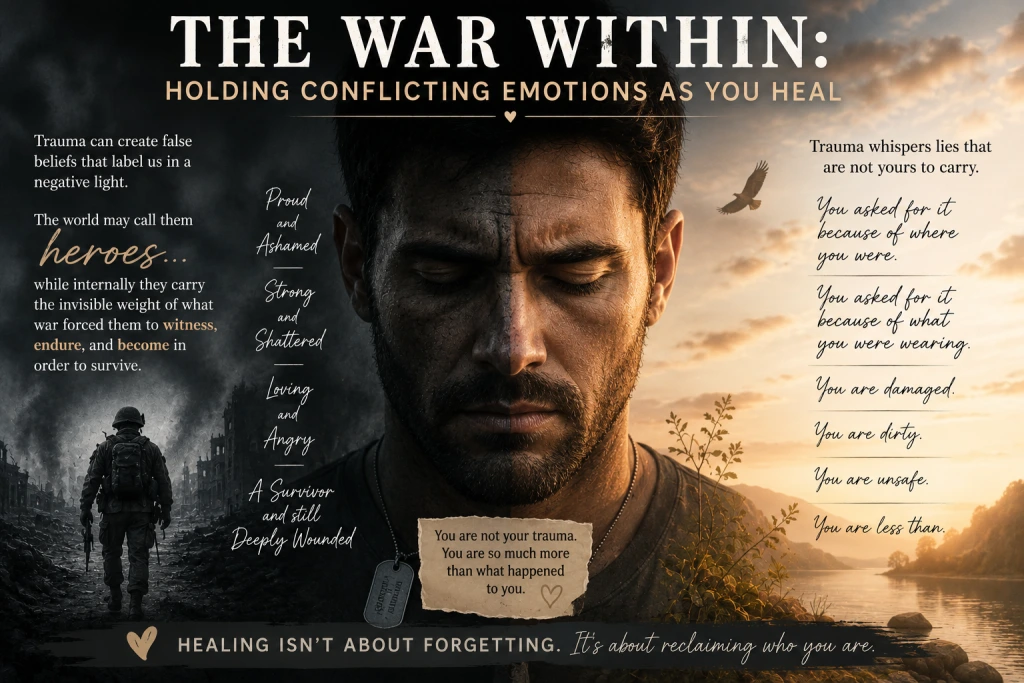
You can be both proud and ashamed.
Strong and shattered.
Loving and angry.
A survivor and still deeply wounded.
Trauma often leaves behind more than painful memories. It creates false identities. It reshapes the way people see themselves until the wound created belief becomes mistaken for the truth.
A veteran may have served their country with extraordinary courage, loyalty, and sacrifice. Yet when they return home, they may not feel honorable. Instead, they replay the horrors they witnessed carrying guilt of the atrocities witnessed. The impossible decisions they had to make. The moments that no human nervous system was ever meant to carry alone.
The world may call them heroes while internally they carry the invisible weight of what war forced them to witness, endure, and become in order to survive.
Both realities can exist at once.
A woman/man/child who was sexually assaulted may intellectually understand that what happened to them was not their fault, yet emotionally they may carry shame in their body like it belongs to them. They may begin to see themselves through the lens of violation instead of survival. Trauma whispers cruel lies:
You asked for it because of where you were.
You asked for it because of what you were wearing.
You are damaged.
You are dirty.
You are unsafe.
You are less than.
Over time, these false beliefs can become fused with identity.
This is one of trauma’s deepest wounds. It does not only injure the body or the mind. It distorts self-perception.
Trauma survivors often become emotionally trapped between what they know logically and what they feel emotionally. This internal conflict can feel unbearable because healing is rarely linear or emotionally clean. A person can simultaneously know they did the best they could and still grieve what happened. They can understand they were victimized and still feel shame. They can love someone and resent the pain that relationship caused. They can miss what harmed them.
This does not make someone weak, broken, or irrational.
It makes them human.
The nervous system stores survival differently than the thinking mind. Trauma responses are not moral failures. They are adaptations. The brain attempts to make meaning out of chaos, and often it does so by placing responsibility onto the self because believing “it was my fault” can feel psychologically safer than accepting how powerless or vulnerable we truly were.
If it was my fault, maybe I can prevent it from happening again.
But healing begins when we slowly separate identity from injury.
A combat veteran is not the war.
A survivor of assault is not the violence committed against them.
A neglected child is not unworthy of love.
A traumatized person is not defective.
The wound is real. But the identity trauma created around the wound is often false.
Healing requires learning to hold conflicting truths without collapsing into shame or guilt. It asks us to create space for grief without allowing grief to define who we are. It asks us to acknowledge what happened while refusing to let trauma become the sole narrator of our story or our identity.
This is not easy work.
Sometimes healing looks less like “moving on” and more like gently untangling yourself from beliefs that were born in survival mode.
And slowly, over time, the survivor begins to realize:
“I am not the worst thing that happened to me.”
“I am not what trauma taught me to believe about myself.”
“I can hold pain without becoming pain.”
That realization is where healing truly begins.

About the Author
Leigh Geffken, MSN, PMHNP-BC
May 28, 2026