A Trauma-Informed, Nervous System–Centered Approach to Healing
At Heart Mind Body, we do not approach trauma as something that is “wrong” with you.
We understand trauma as something your nervous system adapted to carry.
And EMDR is one of the ways we help your system safely release what it no longer needs to hold.
What Is EMDR?
Eye Movement Desensitization and Reprocessing (EMDR) is an evidence-based psychotherapy that helps the brain and body reprocess distressing memories so they are no longer experienced as overwhelming in the present.
Rather than talking about trauma repeatedly, EMDR works with the nervous system directly.
It allows the brain to do what it was always designed to do:
→ process
→ integrate
→ resolve
Our Philosophy: You Are Not Broken
At HMB, we do not see trauma responses as dysfunction.
We see them as:
adaptive
intelligent
protective
EMDR is not about “fixing” you.
It is about supporting your system in completing what was interrupted.
How EMDR Fits Into Trauma Storming™
At Heart Mind Body, EMDR is not used in isolation.
It is integrated into our clinical framework: Trauma Storming™.
Trauma often moves like a storm:
activation builds
overwhelm peaks
the system reacts
the body holds the residue
EMDR helps in the integration phase of the storm cycle:
Storm → Awareness → Regulation → Integration → Resilience
EMDR is where the nervous system:
reprocesses the experience
releases stored activation
updates internal beliefs
restores a sense of safety
What an EMDR Session Looks Like at HMB
Our EMDR sessions are structured, paced, and deeply attuned.
1. Stabilization Comes First
We do not rush into trauma processing.
We begin with:
grounding skills
nervous system regulation
resourcing (internal + external safety anchors)
trust-building
If your system does not feel safe, we do not proceed.
2. Target Selection (With You, Not For You)
We collaboratively identify:
a memory, experience, or pattern
the belief attached to it (e.g., “I am not safe”)
where it lives in the body
You remain in control at all times.
3. Bilateral Stimulation (The Core of EMDR)



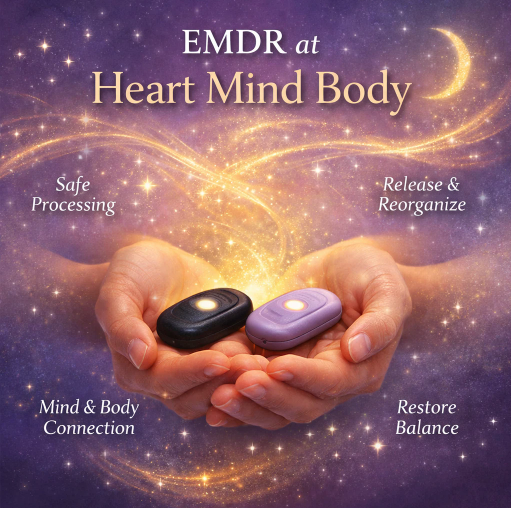
At HMB, we primarily use touchpoint-style bilateral stimulation (gentle alternating tapping in each hand).
This supports:
left/right brain integration
emotional processing
nervous system regulation
You are not forced to relive anything.
You are supported in moving through it safely.
4. Tracking the Nervous System (Not Forcing the Mind)
We pay attention to:
shifts in sensation
emotional movement
emerging insights
Your system leads.
We follow.
5. Integration and Closure
Every session ends with:
grounding
containment
stabilization
You leave feeling:
oriented
supported
regulated
—not activated or exposed.
What Makes EMDR at HMB Different
This is where our work becomes distinct.
We do not use EMDR as a mechanical protocol.
We use it as a relational, nervous system–informed process.
At HMB, EMDR is:
 Trauma-informed (always paced to your system)
Relational (you are not doing this alone)
Body-aware (we track sensation, not just thoughts)
Integrated (part of Trauma Storming™, not separate from it)
Empowering (you are always in control)
EMDR and the Body
Trauma is not just a memory.
It is a state stored in the nervous system.
EMDR allows the body to:
discharge activation
reorganize responses
return to baseline
Many clients notice:
decreased reactivity
improved emotional regulation
relief from intrusive thoughts
a sense of “this is over”
Who Is EMDR For?
EMDR can support:
PTSD and complex trauma
anxiety and panic
relational triggers
medical trauma
childhood experiences that still feel “present”
At HMB, we assess readiness carefully.
Not every moment is the right moment for EMDR.
And that matters.
What EMDR Is Not
Let’s be clear.
EMDR is not:
reliving trauma without support
being overwhelmed in session
losing control
a quick fix without preparation
If it feels like too much, we slow down.
Always.
Our Commitment to You
At Heart Mind Body, we honor this truth:
You survived something your system had to organize around.
EMDR is not about erasing that.
It is about helping your system realize:
“This is no longer happening.”
Closing Reflection
Healing is not about becoming someone new.
It is about becoming unburdened from what was never yours to carry alone.
EMDR is one path.
And at HMB, you do not walk it alone.