🍂🎃 October Neurofeedback Special 🎃🍂 Click Here To Learn More
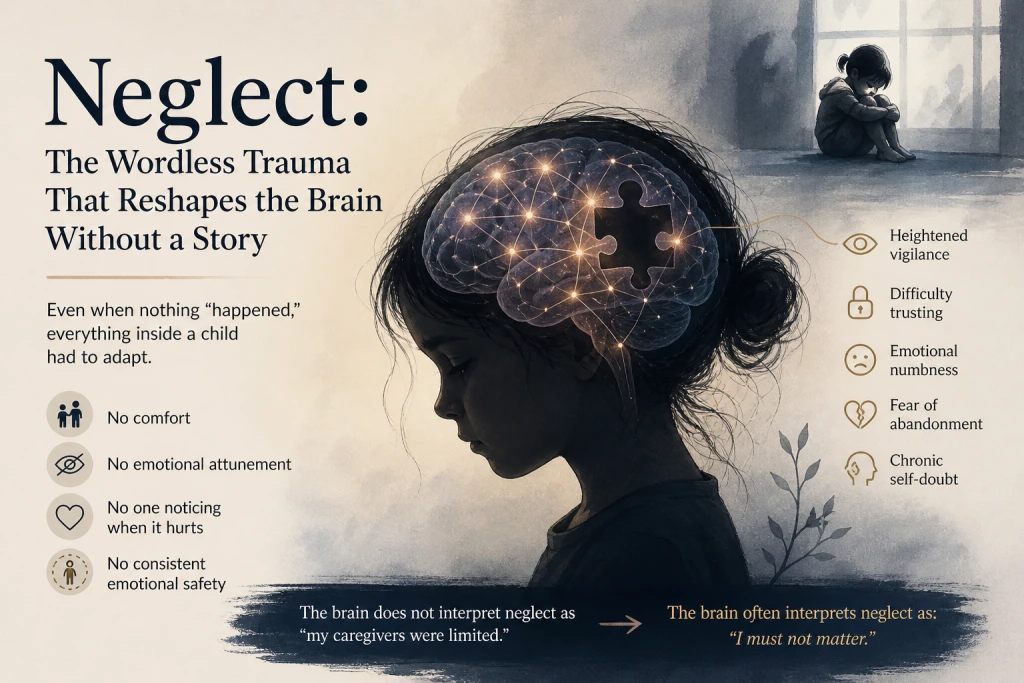
Not all trauma comes from what happened to us.
Some trauma comes from what didn’t happen.
No comfort.
No emotional safety.
No attunement.
No consistent love.
No one noticing when we were hurting.
Neglect trauma is often invisible because there may not have been screaming, violence, or obvious chaos. From the outside, life may have looked “fine.” But the nervous system tells a different story.
A child’s brain is built in relationship. The brain learns safety, connection, self-worth, and emotional regulation through repeated experiences of being seen, soothed, protected, and emotionally responded to. When those experiences are missing, the brain adapts for survival.
The tragedy is this:
The brain does not interpret neglect as “my caregivers were limited.”
The brain often interprets neglect as:
“I must not matter.”
Over time, this changes the architecture of the nervous system.
When a child grows up emotionally unsupported, the brain becomes highly focused on survival rather than growth.
Instead of developing from a foundation of safety, the nervous system develops around unpredictability, emotional loneliness, or emotional deprivation.
This can lead to:
Chronic hypervigilance
Anxiety
Emotional numbness
Difficulty trusting others
Fear of abandonment
Over-independence
People-pleasing
Difficulty identifying emotions
Feeling “too much” or “not enough”
Constant scanning for rejection or danger
The brain begins organizing itself around one question:
“How do I survive emotionally in an environment where my needs are not consistently met?”
That survival adaptation is intelligent.
But survival wiring can become painful in adulthood.
Neglect trauma can affect multiple parts of the brain and nervous system.
The amygdala helps detect danger. In neglect trauma, it can become overly sensitive. The brain learns to stay alert for emotional threat, criticism, rejection, or abandonment.
This is why some people:
Overreact to tone changes
Feel easily rejected
Panic when relationships feel uncertain
Live in chronic tension without understanding why
The brain learned that emotional safety was inconsistent.
The prefrontal cortex helps with:
emotional regulation
impulse control
decision-making
perspective-taking
calming the nervous system
Chronic stress and emotional neglect can reduce the brain’s ability to regulate overwhelming emotions effectively.
This can create experiences like:
emotional flooding
shutdown
spiraling thoughts
difficulty concentrating
feeling emotionally “stuck”
The person is not weak.
Their nervous system adapted under stress.
The hippocampus helps organize memories and distinguish past from present.
Trauma can interfere with this process, causing old emotional pain to feel current and immediate.
This is why adulthood experiences can sometimes trigger disproportionately intense emotional reactions. The nervous system is not only reacting to the present moment — it is reacting to layers of unresolved emotional history underneath it.
Children who experience neglect frequently become adults who minimize their pain because “nothing terrible happened.”
But emotional neglect teaches children to disconnect from themselves.
Many survivors become:
highly functional
caretakers
achievers
emotionally independent
hyper-responsible
Yet underneath may live:
profound loneliness
shame
emotional exhaustion
fear of needing others
difficulty receiving love
The wound is not always dramatic.
Sometimes the wound is the absence of emotional nourishment.
The brain can change.
This is one of the most hopeful truths in neuroscience.
The nervous system can begin healing through:
safe relationships
therapy
emotional attunement
mindfulness
body-based healing
nervous system regulation
consistent self-compassion
corrective emotional experiences
Every moment of safety sends new signals into the brain.
Over time, the nervous system can slowly learn:
“I am safe now.”
“My needs matter.”
“Connection does not always lead to pain.”
“I do not have to survive the way I once did.”
Healing is not becoming someone new.
Healing is teaching the brain it no longer has to live in survival mode.
Neglect trauma is deeply misunderstood because it is often quiet, subtle, and invisible. But invisible wounds still shape the nervous system.
A neglected brain did not become “damaged.”
It became adaptive.
The very patterns that now create suffering were once attempts to survive emotional deprivation.
Understanding this changes everything.
Because when we stop viewing ourselves through the lens of shame, we can finally begin viewing ourselves through the lens of compassion.
And compassion is one of the safest places the brain can begin to heal.

About the Author
Leigh Geffken, MSN, PMHNP-BC
May 6, 2026