🍂🎃 October Neurofeedback Special 🎃🍂 Click Here To Learn More
Many people living with PTSD ask themselves the same painful question:
“Why can’t I just get over it?”
The answer is simple: PTSD is not a character flaw. It is a brain and nervous system injury caused by overwhelming experiences.
Understanding what happens inside the brain can remove shame and replace it with compassion. PTSD is not a sign that you are broken. It is evidence that your brain did exactly what it was designed to do—survive.
The human brain is constantly scanning the environment asking one question:
“Am I safe?”
When the answer is yes, the brain allows us to relax, connect with others, think clearly, learn, and enjoy life.
When the answer is no, the brain activates survival mode.
This survival response is commonly known as:
Fight
Flight
Freeze
Fawn (people-pleasing to stay safe)
In a dangerous situation, these responses are lifesaving.
The problem occurs when the danger ends but the brain continues to act as though the threat is still present.
That is PTSD.
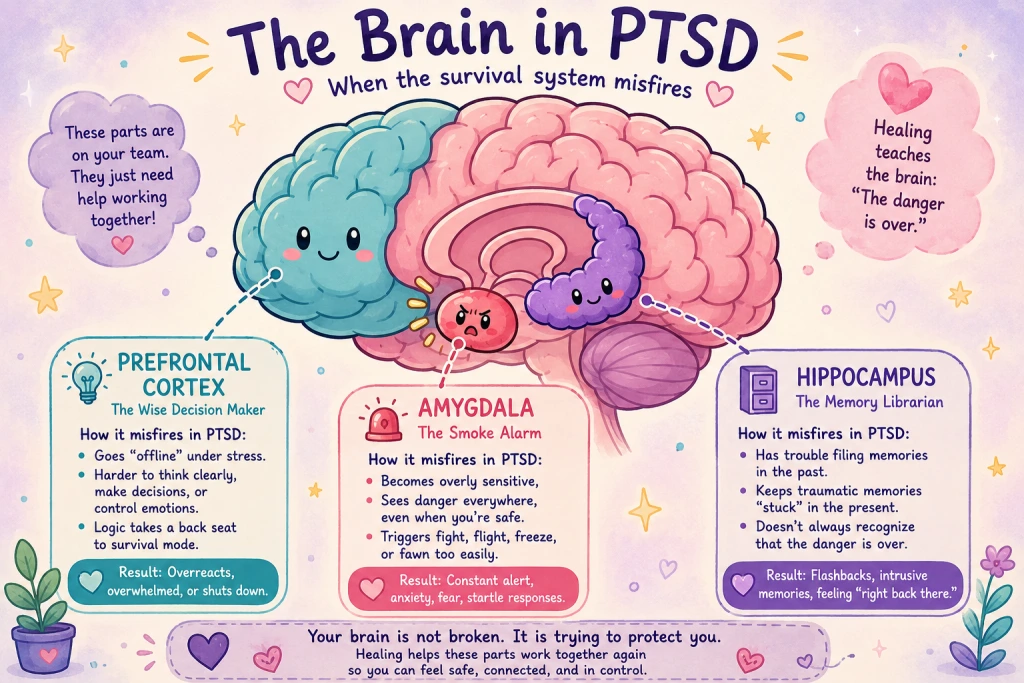
The amygdala is the brain’s alarm system.
Its job is to detect danger and trigger a survival response.
Imagine a smoke detector in your home.
In PTSD, the smoke detector becomes extremely sensitive.
Instead of only responding to real fires, it may react to:
Certain smells
Loud noises
Specific locations
A tone of voice
Conflict
Anniversaries of traumatic events
Emotional closeness
The amygdala is not trying to hurt you.
It is trying to protect you.
Unfortunately, it begins seeing danger everywhere.
The hippocampus helps organize memories and place them in the past.
Under normal circumstances, memories get filed away with a label that says:
“This happened before. It is over now.”
Trauma disrupts this process.
Instead of becoming a completed memory, traumatic experiences can remain unfinished.
As a result, the brain may react as though the trauma is happening right now rather than years ago.
This is why a veteran may dive for cover after hearing fireworks.
This is why a survivor of assault may feel panic when encountering someone who resembles their attacker.
The body reacts before logic has time to catch up.
This part of the brain helps with:
Logic
Planning
Decision-making
Emotional regulation
Perspective
Think of it as the wise leader of the brain.
Under extreme stress, this area partially goes offline.
The brain shifts control to survival systems because thinking takes too long during danger.
During a traumatic event, survival is more important than reasoning.
The challenge is that many people with PTSD continue living in this survival state long after the trauma has ended.
Many people assume PTSD is only emotional.
It is not.
Trauma affects the entire nervous system.
This can lead to:
Muscle tension
Headaches
Digestive problems
Insomnia
Fatigue
Chronic pain
Increased heart rate
Hypervigilance
Startle responses
The body is carrying the burden of staying prepared for a threat that no longer exists.
In many ways, PTSD is a nervous system condition as much as it is a psychological one.
This is the most important part.
The brain is not fixed.
It is constantly changing through a process called neuroplasticity.
Every time a person learns a new coping skill, processes a traumatic memory, practices mindfulness, completes EMDR, engages in therapy, builds healthy relationships, or experiences safety, the brain begins creating new pathways.
Healing does not erase the past.
Healing teaches the brain:
“The danger is over. I survived.”
Over time, the smoke alarm becomes less reactive.
The filing cabinet begins organizing memories correctly.
The wise decision-maker regains control.
PTSD is not a weakness.
It is not attention-seeking.
It is not laziness.
It is not a lack of willpower.
PTSD is the result of a brain and nervous system that became exceptionally skilled at survival.
The goal of treatment is not to erase what happened.
The goal is to help the brain learn the difference between then and now.
Because when the nervous system finally understands that the danger has passed, healing becomes possible.
If you live with PTSD, remember this:
Your symptoms are not evidence that you are broken. They are evidence that you survived something difficult.
The same brain that learned fear can learn safety.
The same nervous system that adapted to trauma can adapt to healing.
And sometimes the first step toward recovery is understanding that your reactions make sense when viewed through the lens of neurobiology.
There is nothing wrong with you. Your brain has simply been trying to protect you for a very long time.
Healing begins when we stop asking, “What’s wrong with me?” and start asking, “What happened to me?”
— Heart, Mind, Body LLC | Trauma-Informed Care & Healing

About the Author
Leigh Geffken, MSN, PMHNP-BC
June 17, 2026