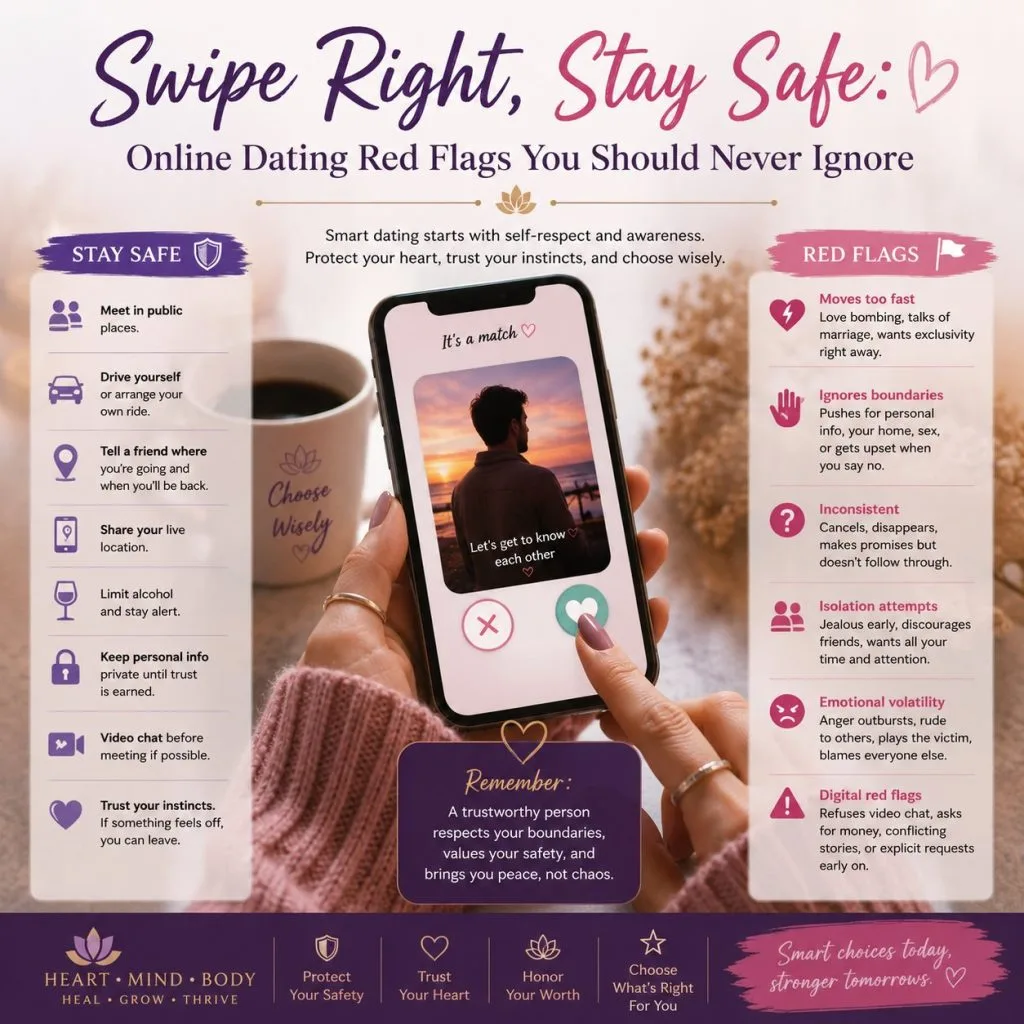
Swipe Right, Stay Safe: Online Dating Red Flags You Should Never Ignore Banner

Swipe Right, Stay Safe: Online Dating Red Flags You Should Never Ignore

Online dating can lead to wonderful relationships, but it also requires balancing openness with good judgment. The first few weeks are less about deciding whether someone is “the one” and more about determining whether they are safe, emotionally healthy, and consistent.

Safety Tips for the First Several Dates

  • Meet only in public places (coffee shops, restaurants, parks, museums) until trust has been established.
  • Drive yourself or arrange your own transportation. Avoid being dependent on your date for a ride.
  • Tell a trusted friend where you’re going, who you’re meeting, and when you expect to return.
  • Share your live location with someone you trust during the date.
  • Limit alcohol or other substances that could impair your judgment.
  • Keep your home address and workplace private until you know the person well.
  • Video chat before meeting if possible. It helps confirm they are who they claim to be.
  • Trust your instincts. If something feels “off,” you don’t need proof to leave.

Healthy Green Flags

Early attraction can make it easy to overlook healthy behaviors because they often feel less exciting than intensity. Look for someone who:

  • Is consistent between words and actions.
  • Respects your boundaries without guilt-tripping.
  • Accepts “no” gracefully.
  • Speaks respectfully about former partners.
  • Is willing to answer reasonable questions honestly.
  • Has friendships and interests outside dating.
  • Doesn’t pressure you for exclusivity immediately.
  • Makes you feel calmer, not more anxious.

Healthy relationships tend to grow through consistency, not intensity.

Red Flags During the First Few Weeks

They Move Too Fast (“Love Bombing”)

  • Talking about soulmates immediately.
  • Discussing marriage within days.
  • Excessive compliments that don’t match how well they know you.
  • Pressuring for exclusivity almost immediately.

They Ignore Boundaries

  • Push for your address.
  • Want to come to your home early.
  • Pressure you into sex.
  • Become upset when you say no.

A respectful partner may be disappointed, but they won’t punish you for having boundaries.

Inconsistency

Pay attention if they:

  • Frequently cancel plans.
  • Disappear for days without explanation.
  • Promise things but rarely follow through.
  • Tell stories that don’t quite add up.

Consistency predicts trust far better than charm.

Isolation Attempts

Be cautious if they:

  • Want all your free time.
  • Discourage seeing friends.
  • Get jealous very early.
  • Want constant texting throughout the day.

Healthy partners encourage independence.

Emotional Volatility

Early warning signs include:

  • Explosive anger.
  • Road rage.
  • Yelling at waitstaff.
  • Blaming everyone else for problems.
  • Playing the victim in every story.

How someone treats strangers often predicts how they’ll eventually treat a partner. If you find yourself managing someone else’s moods this early, our article on walking on eggshells around a fragile ego explains where that dynamic tends to lead.

Digital Red Flags

  • Refuses to video chat.
  • Won’t answer basic questions about work or life.
  • Multiple social media accounts with conflicting information.
  • Immediately asks for money.
  • Requests explicit photos early.
  • Claims repeated emergencies requiring financial help.

These are common signs of romance scams.

Questions Worth Asking Yourself After Each Date

Instead of asking only, “Did they like me?” also ask:

  • Did I feel safe?
  • Could I be myself?
  • Did they respect my boundaries?
  • Were they curious about me as a person?
  • Did I leave feeling peaceful or confused?
  • Were their actions consistent with their words?

These questions shift the focus from earning someone’s approval to evaluating whether they are a good fit for you.

Listen to Your Nervous System — But Verify

For people with a history of trauma, this can be tricky. Sometimes the nervous system reacts to genuine danger, and sometimes it reacts because healthy intimacy feels unfamiliar. A useful approach is to combine intuition with observable facts:

  • Feelings: “Something feels off.”
  • Evidence: “They canceled three dates, ignored my boundary, and became angry when I said no.”

When both your intuition and the evidence point in the same direction, take that seriously. If your feelings and the facts don’t align, slow down, gather more information, and avoid making major commitments until you have a clearer picture.

A Simple Rule

A trustworthy person does not ask you to sacrifice your safety, values, boundaries, or peace of mind in order to keep the relationship. The right relationship usually feels less like an emotional roller coaster and more like a steady climb — predictable, respectful, and emotionally safe.

If you notice that old wounds keep writing the story before the facts are in, our post on facts vs. feelings can help you tell the difference — and our team is always here if you would like support in dating from a place of clarity rather than fear.

Professional headshot of woman with blonde hair wearing cream blazer

About the Author

Leigh Geffken, MSN, PMHNP-BC

I blend kindness, neuroscience, mindfulness, and psychodynamic principles to treat the whole person, not just the diagnosis.
Where Your Heart, Mind, and Body Feel Supported.
Professional headshot of woman with blonde hair wearing cream blazer
Leigh Geffken, MSN, PMHNP-BC

July 31, 2026